The third meeting of the Panel took place on February 12th. The agenda circulated in advance (which will be on the OPDC web pages for the Panel) did not include all the items which we had asked in advance to be discussed. But OPDC relented and we were able to raise these topics.
HS2’s Peter Gow attended the meeting, which was very welcome. Peter is project manager for Old Oak Common station. His important news was that the outcome of the ‘comprehensive reset’ of the HS2 project should be announced before the end of February.
The timeline for the opening of the Birmingham to Old Oak HS2 line will still not be be a firm date, but as a range of years (as was the previous 2029-33 forecast). The announcement will probably include new governance arrangements for HS2, and without giving final revised costs. But local residents at Old Oak may at least gain a better idea of how much longer the disruption to their lives will continue (2026 was the original date for completion of the project).
The recent start of the tunnelling between OOC station and Euston is seen by HS2 and OPDC as a vote of confidence in what remains of the HS2 project. Plans for a Euston terminus are still not finalised, nor funded. This part of the overall project is now handled by the Department for Transport and not by HS2 Ltd.
The Panel meeting discussed the continining difference of view between the Old Oak Neighbourhood Forum and OPDC, on the ‘material weight’ and importance of OPDC’s new Masterplan Framework. While OONF agrees that this 200 page document can be a ‘material consideration’ in future planning decisions, we don’t accept that its proposals should override the adopted 2022 OPDC Local Plan. The Local Plan is the statutory context for deciding all applications, consulted on and ‘examined’ by a Planning Inspector.
The Masterplan Framework is described as ‘illustrative’ but the published version also includes a paragraph saying that all applications for development must take account of its contents. Our view is that the document has only limited material weight, as compared with an adopted local plan. This lack of certainty may trouble the prospective ‘master developers’ with whom OPDC hope to enter into joint ventures to deliver their new Masterplan.
The position will change over time, once OPDC’s promised review of the 2022 Local Plan gets underway. In the meantime we have had to agree to disagree with OPDC on this subject. The background is covered in a separate post on this website, updated to include our most recent letter to OPDC.
We also raised at the Panel what we see as misleading claims by OPDC that the Masterplan area is ‘well connected‘ to public transport. While this may be true for those living close to Willesden Junction or North Acton station, the areas inbetween have poor connectivity (using existing standarsd measures). Our members at Old Oak see local bus services as worse now than a decade ago.
The situation will of course change once Elizabeth Line platforms are operational at OOC station. But HS2 say that early opening of these lines would only be shortly in advance of the remainder of the rail interchange. Government support and funding for the West London Orbital, with a new rail station in Old Oak Common Lane would be another game changer. But for the time being the Government has given priority for investment to the DLR Extension in east London.
We feel that we have to keep reminding OPDC that improvements to the transport network at Old Oak remain a future prospect and not a present reality. Until new infrastructure is in place, much of the Masterplan area remains unsuitable for high density/high rise/car free housing of the kind envisaged in the Masterplan.
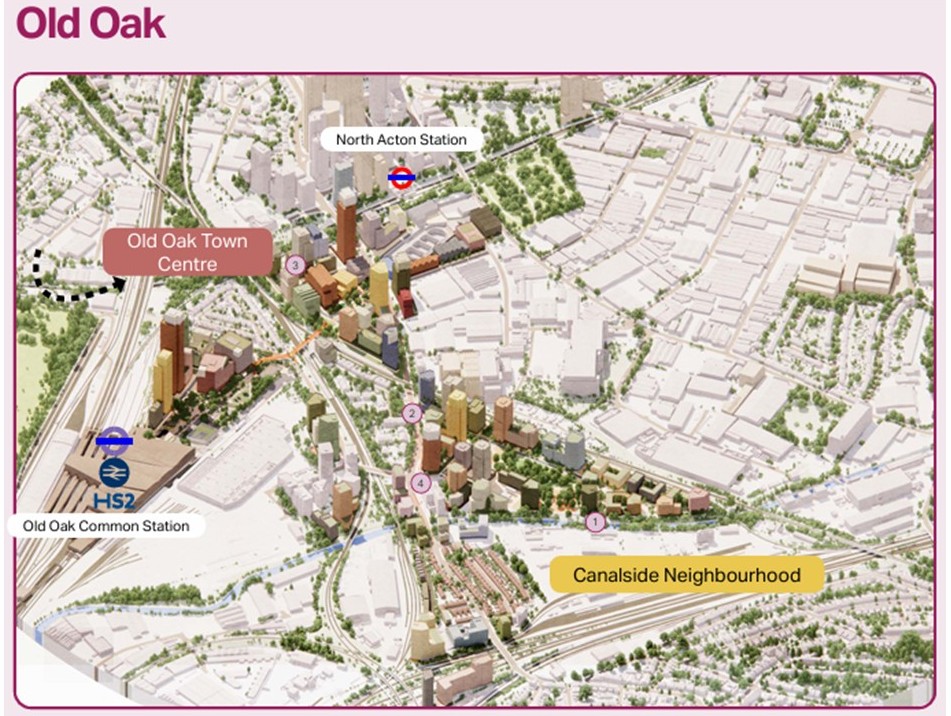
Image from OPDC’s 2025 Masterplan Framework
OONF slide set questioning OPDC’s current approach to their delivery plans
At the last OONF/GUA Zoom session we looked at a set of slides intended to provide some challenge and critique to OPDC’s insistence on proceeding ‘at pace’ with its delivery ambitions. Until new transport infrastructure has arrived, building ‘more of the same’ high rise/car free apartments as shown in the Old Oak Masterplan area does not seem to us to be exemplary urban renewal
‘Part 1’ of this slide set is below. As explained to OPDC at the Panel meeting, we wanted the Chair Dame Karen Buck and chief executive Matthew Carpen to be aware of their content – as we will be using some of these slides when approaching London Assembly members, Borough Leaders and officers, and other local groups about our proposed 2026 Draft Old Oak Neighbourhood Plan.
As discussed at recent monthly Zoom sessions, we are reviving the idea of submitting to OPDC a Draft Neighbourhood Plan. OPDC would then need to publish and consult on this for 6 weeks, before ‘examination’ of the Draft Plan by an independent examiner.
Such a neighborhood plan would offer an alternative way forward for OPDC, should they find that investment interest from the major developers being sought as delivery partners turns out to be not as strong as OPDC hope.
As has been widely resported, there is limited interest in new housing construction in London at present given lack of financial viability. It remains to be seen if the MHCLG/Mayoral ’emergency package’, reducing affordable housing requirements (along with CIL charges) has much impact.
We are suggesting the neighbourhood plan route as a contingency option, should OPDC’s plans come unstuck at a difficult time in the London development market. This alternative route would involve lower density mid-rise housing on the sites which OPDC has purchased, perhaps with the GLA working more directly with housing associations and contractors using Modern Modular Construction techniques – at scale and at speed.
No sign of any enthusiasm from OPDC as yet. Before the end of February we will discuss with officers the feasibility of a ‘co-operative’ neighbourhood plan. This would include the scope for extending the 2021 neighborhood boundary to cover most of the Masterplan area. A neighbourhood plan, if successful at a local referendum, has the full statutory weight of the Local Plan. Once next steps become more clear, the earlier draft neighbourhood plan which has sat on this website since 2021 will be replaced with a new version. Local consultation would then get underway.