The consultation closed on October 15th. OONF submitted a response which can be read and downloaded below.
We have supported several features of this new version including Pollcy MBUL2 which restores a clearer link between transport connectivity and housing density. But we have also flagged up risks of too much reliance on Transport for London’s new Sustainable Access Measure.
This is a new system of scoring the connectivity of every 100m grid square across London. It is designed to show how easily a typical Londoner in a given location can reach jobs, services, and amenities using public transport and walking.
The model built by TfL includes all committed and funded transport improvements up until 2041. These include Old Oak Common station, with its HS2, GWR and Elizabeth Line Platforms. As a result the ‘SAM scores’ for the surrounding area are higher than the reality on the ground today.
The risk is that HS2, OPDC and developers will continue to claim that this part of London (including the Old Oak neighbourhood area) is already ‘well connected’. Those that live and work here know this is not true, and may not become true for a further 10-15 years.
Our response to the Draft London Plan also suggests a fundamental rethink and preparation of a joined-up new masterplan for both the Kensal Canalside Opportunity Area and the eastern half of the OPDC Opportunity Area. If the Cargiant site were to be brought back into the mix, there would be scope for large-scale housebuilding programme and a new street network across all three large parcels of land.
We argue the case for using Modern Modular Construction to build mid-rise housing across all three areas, with good access to both ends of Old Oak Common station. One of the present HS2 construction compounds could provide a factory site for fabricating the panels for modular housing construction at scale.
We are suggesting that the GLA Housing and Land Directorate should take on oversight of such a project, applying the same principles as proposed for London’s two potential new towns at Crews Hill and Chase Park in Enfield, and Thamesmead Waterfront in Greenwich. These have been defined by the London Assembly’s Planning and Regeneratio Committee as:
Guaranteeing high levels of affordable housing, with social rent prioritised.
Ensuring transport infrastructure is in place from day one.
Embedding high-quality green infrastructure to support climate resilience.
Requiring meaningful community co-design from the earliest stages.
Securing new, dedicated government funding and greater powers for land value capture.
The Forum will be discussing our response to the Draft London Plan at the next meeting of the OPDC Residents Panel on 29th October.
The Old Oak Alliance is a coalition of local community groups representing more than 10,000 residents impacted by HS2 and OPDC development. The Alliance has a busy WhatsApp group and works alongside the Old Oak Neighbourhood Forum.
Most of the work of the group relates to HS2 plans, proposals, and construction works. The Alliance on 12th October sent this 8 page letter to Heidi Alexander MP, Secretary of State for Transport.
London Plan policies on housing density on major sites have long been based on net rather than gross residential densities. These net figures remove from calculations on site capacity those areas of land to be used for streets, open spaces, schools, GP surgeries or other non-residential uses.
Planned density levels affect the choice of building typologies used by architects and scheme designers, whether this be mid‑rise blocks, mansion blocks, terraces, perimeter blocks, or high-rise towers. Net densities are measured in terms of ‘dwellings per hectare’ (dph) or by ‘habitable rooms per hectare’ (hrh). The latter measure gives more detail on the proposed ‘dwelling mix’ of small flats/studios and larger family homes.
The 2021 London Plan removed the former Policy 3.4 and ‘Density Matrix’ that made a link between acceptable densities and levels of access to public transport. The terminology of high, medium and low densities continues to be used – even though these levels have moved steadily upwards in the past decade especially in London’s Opportunity Areas.
Typical density ranges for major London developments in Opportunity Areas, calculated as dwellings per hectare, are as below:
Low OA density: <150 dph (rare; usually edge sites)
Medium OA density: 150–250 dph (mid-rise blocks, 4–8 storeys)
High OA density: 250–350 dph (8–12 storeys, high levels of access to public transport)
Very high OA density: >350 dph (tall-building clusters with the highest levels of access to public transport).
In recent years, since the demise of the London Plan Density Matrix, many developers have become reluctant to reveal figures on density in their planning application material. They argue that this information no longer has to be be provided.
The Earls Court Development Company refused last year to publish net residential density figures, making it hard for the public to compare their proposals against others in West London. Requests for this information from local amenity societies were rebuffed. ECDC’s Planning Statement gave a ‘whole site average’ figure of 155 dwellings per hectare. This was clearly a gross rather than net figure, given the schemes proposals as shown in the CGI below.
CGI of Earls Court consented development
Developers Ballymore at the Kensal Canalside Opportunity Area provided net residential figures for their proposals (these were consented by RB Kensington and Chelsea in November 2025 but still await a Mayoral ‘Stage 2’ decision). Ballymore claimed an average net residential density of 330 housing units per hectare. This is ‘high density’ for a development with poor public transport access, but not as high as the cluster of towers built in recent years at at White City East (at around 700 dph net).
CGI of Ballymore proposals for Kensal Canalside
OPDC responses to consultation on the Draft Old Oak Neighbourhood Plan
On September 8th, OPDC published two sets of responses to the Forum’s consultation on a Pre-submission version of our draft neighbourhood plan. The response from OPDC as a local planning authority has been made available and commented on in a previous post on this website.
The second response, from OPDC as a Delivery Agency, is available below:
What has come as a surprise in both responses is a new claim from OPDC that the 2022 OPDC Local Plan residential density range of 300-600 dwellings per hectare ‘is based on gross densities’.
OONF has immediately questioned this claim. The difference between gross and net densities is significant. Never before has OPDC made such a claim or explained that its (very limited) statements in the 2022 Local Plan refer to gross rather than net density. When gross residential densities are converted to net, the density level goes up. There is no single conversion factor but a net developable area as 60-70% of the overall site area is a rough guide used by the development industry.
When converted from gross to net residential density figures, a ‘density band’ of 300-600 dwellings per hectare would equate (by our calculations) to achieving levels of net residential density at 800-1,000 dph across multiple sites in the Old Oak Masterplan area.
While the OPDC Masterplan Framework shows images with many tall buildings, we cannot see how such ‘hyper-densities’ could be built across a wide area. There are cases of confined individual plots thast have been built at above 1,000 units/hectare in the North Acton Cluster (such as the Icon building at One West Point). But building at an average net density at this level across the Old Oak ‘project area’ would be a very different matter.
A copy of our email to OPDC officers, seeking urgent clarification on these unexpected new references to gross density levels of 300-600 dph is below. If the Earls Court scheme shown above involves site-wide gross densities around 155 dwellings per hectare, imagine what would be involved in enabling OPDC’s potential ‘master developer partner’ to build at gross densities of 300-600 dph.
This consultation exercise was due to conclude on September 8th 2026, but has taken an unexpected turn. At its open meeting on September 8th, Forum members will be recommended to agree to a 2 week extension and a revised closing date of September 22nd.
This extension is for several reasons, including the new National Planning Policy Framework which came into instant effect on August 17th, and the consultation launched by the Mayor of London on a full draft of the next London Plan. Both these publications have significant implications for OPDC and for the content of a neighbourhood plan for Old Oak.
A third reason needs a brief explanation. The agenda for the OPDC Planning Committee was published on September 3rd. The report from the Director of Planning covered the subject of the Draft Neighbourhood Plan and said at paragraph 5.2 OPDC, in its capacity as LPA, has submitted a response to the Forum’s consultation. OPDC’s Delivery Directorate has submitted a separate response, reflecting its role as a landowner.
Our Forum had received no such responses at this time. OPDC officers subsequently explained at the OPDC Residents Panel on September 3rd that this wording was used because the September 8th deadline for the Forum’s consultation had not allowed these consultation resp0nses to be discussed at the Planning Committee on the 10th. The responses had therefore been circulated informally to Planning Committee and Board members (including the Leaders of Ealing, Brent and Hammersmith & Fulham). The Committee on the 10th would be asked to ‘note’ these retrospectively rather than to discuss and approve/amend them.
We explained at the Residents panel that this was an unsatisfactory process. No request had been for submitting committee-approved responses a few days late. Residents of North Acton ward in Ealing (and in the wider area) want to hear the views from Ealing, and of councillors from Brent and LBHF on the Planning Committee, on the proposeals in the draft neighbourhood plan.
As explained in previous posts on this website, the neighbourhood plan proposes lower housing densities and building heights than those assumed in OPDC’s 2026 Masterplan Framework.
Hence an extended deadline for responses makes sense from several viewpoints.
OPDC’s consultation response (in its role as local planning authority) was received by the Forum on the morning of September 8th. It is a 37 page document as posted below: As of the afternoon of September 8th a late addendum report has been added to the published agenda of the Planning Committee on the OPDC website, including this response.
The legal opinion from Richard Moules KC, referred to in the response, dates from April 2026 and is already posted on this website. The Forum continues to disagree with OPDC on its methodology for calculating a Indicative Housing Requirement figure.
This remains the most critical issue of those that an independent Examiner will need to decide, as an when a revised Submission version of the Draft Neighbourhood Plan reaches the examination stage in the process of preparation and adoption. Meanwhile the OPDC response identifies numerous other aspects of the Pre-submission Drfat with which the planning authority finds fault for one reason or another.
It is not unsual for local planning authorities to resist proposals in a neighbourhood plan, and to challenge the extent to which policies and proposals in the adopted Local Plan can be varied. In this case the OPDC Masterplan Framework is a non-statutory document which has not gone through the stages of public consultation, examination by a Planning Inspector, and subequent adoption. So the situation is an unusual one.
Following a 2 week extension to the Pre-submission consultation, the Forum will be revising the content of its Draft Plan. A finalised Submission Version will be submitted to OPDC along with the required Consultation Statement and Basic Conditions Statement.
In the meantime comments and responses from local residents and businesses to the Draft Plan (available to read and download on this website) are very welcome, before 22nd September 2026. These can include views on OPDC’s response as planning authority. The promised separate response from OPDC as landowner and delivery agency has yet to be received by the Forum (as of 8th September),
This is becoming something of a David and Goliath battle between the Forum and a well resourced Development Corporation.
The Forum’s open meeting on July 2nd agreed to the start of an two month public consultation from July 8th to September 8th on our Draft Neighbourhood Plan 2026-40. This ‘Pre submission Consultation version’ of the Plan can be read and downloaded below:
This is the statutory Regulation 14 consultation which the Forum is required to carry out. All responses, and how the Forum intends to address these, will be incorporated in a Consultation Statement. A further and final Draft Plan will then be submitted to OPDC, with changes resulting from the consultation. This ‘submission version’ will be accompanied by the Consultation Statement and a Basic Conditions Statement.
OPDC is then required to undertake their own six week ‘publicity’ consultation via their website, to widen awareness of the Draft Neighbourhood Plan and its proposed policies and site allocations.
We are still at odds with OPDC officers on the methodology they have used to come up with their proposed Indicative Housing Requirement for the Draft Plan. This identifies five development sites lying within the neighbourhood area. Four of these are not sites allocated in the 2022 Local Plan (the exception being the Lords site at Channel Gate)
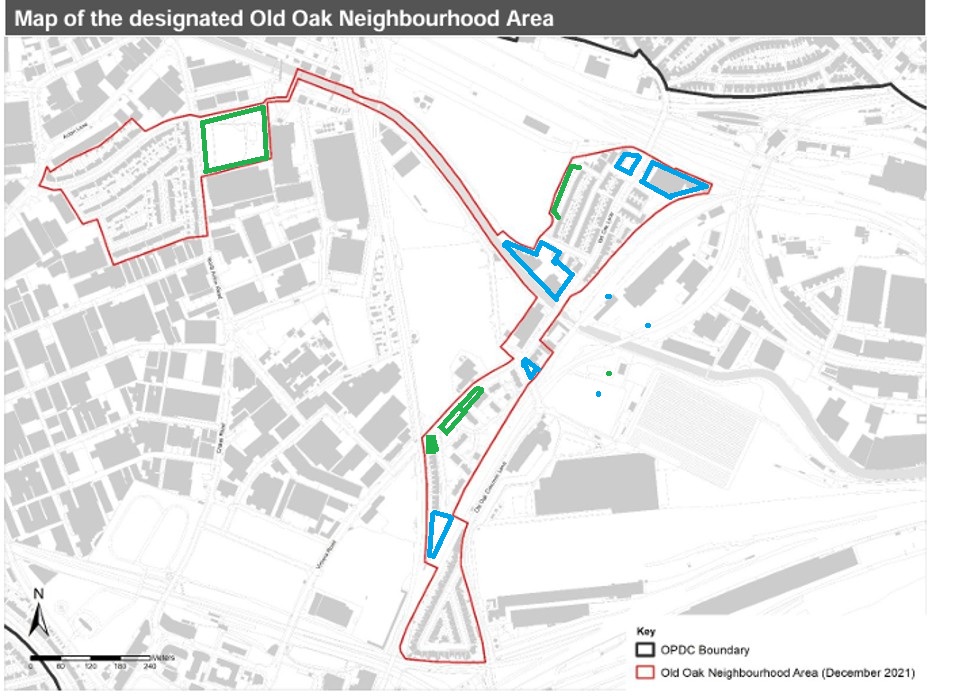
Map of the five development sites proposed in the Draft Oak Neighbourhood Plan
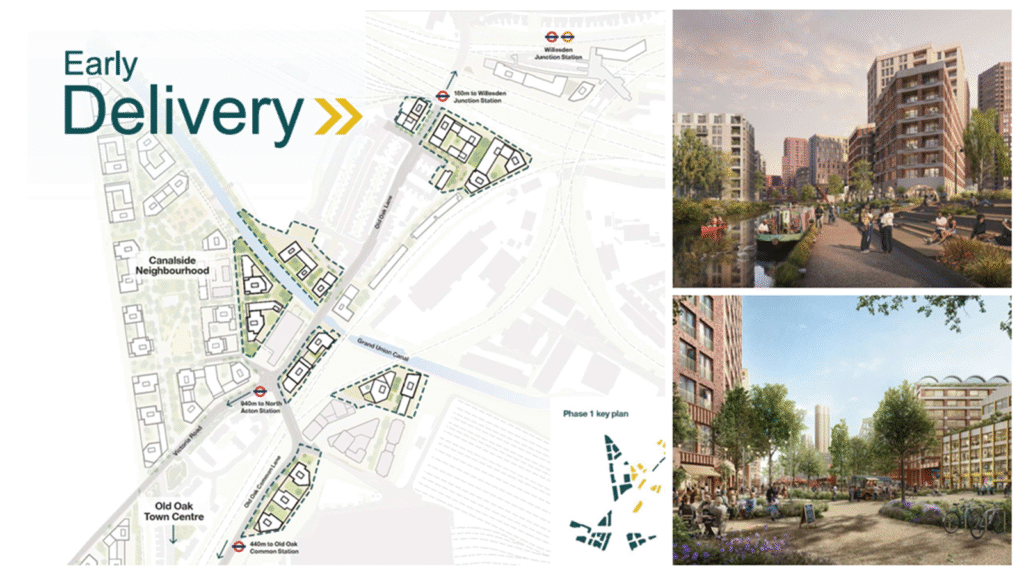
These sitesare however amongst the seven ‘Phase 1’ development plots packaged together as the proposed first set of developments identified for those potential master development partners currently choosing whether to bid to be selected as OPDC’s ‘joint venture partner’ from early 2027. The joint venture arrangement is expected to last several decades and potentially to 2050.
The seven development sites proposed by OPDC for ‘early delivery’by a chosen joint venture partner
OPDC has acknowledged that For avoidance of doubt, OPDC is not relying on the Masterplan Framework to underpin the IHR (Indicative Housing Requirement) methodology or the minimum indicative housing requirement for the Old Oak Neighbourhood Plan. The Masterplan Framework is not a statutory planning document, and we are glad to see that this position has been accepted by OPDC.
OPDC instead argue that that same four sites feature in a 2021 Development Capacity Study and ‘therefore form part of the Local Plan‘. We believe this to be legally incorrect. The independent Examiner of the Draft Neighbourhood Plan is likely to need to adjudicate on this issue, further down the line.
As explained on the page of this website for the Old Oak Neighbourhood Plan, we are having legal arguments with OPDC planning officers over the next stage of progressing the Forum’s updated Draft Plan.
Several issues are involved. OPDC has commissioned an Opinion from Richard Moules KC of Landmark Chambers. On a non-precedent basis OPDC has provided us with a full copy of this Opinion (see below).
Two main issues are involved:
The Opinion argues that the Forum cannot simultaneously progress an area application and a neighbourhood plan which is prepared on the basis of a different geographic area compared to that specified in the area application. We sent OPDC in January an initial draft of an application to extend the boundary of the neighbourhood area designated in 2021, to include much of the OPDC Masterplan area. We maintain that submitting a draft neighbourhood plan and applying to vary the boundary are separate legal processes. This is a hypothetical issue at present, as the timeline for OPDC’s procurement of a master development partner now extends into 2027. We can wait to see how this process goes before applying to change the neighbourhood boundary.
A draft neighbourhod plan has to be ‘independently examined’ before it can proceed to a local referendum. Examination involves demonstrating compliance with a set of ‘Basic Conditions’. The most significant of these has changed recently as a result of clauses in the 2023 Levelling Up and Regeneration Act. The previous condition of showing ‘general conformity’ with the ‘strategic policies’ in the local plan for the area has been replaced. The new condition focuses on housing delivery and requires a neighbourhood plan to deliver no less housing than in the local plan. The Forum has been set by OPDC an Indicative Housing Requirement of 510 new homes across the five development sites that lie within the neighbourhood area. Four of these five sites, we argue, are not included in the site allocations in the 2022 OPDC Local Plan. They are sites identified in a 2021 Development Capacity Study. This type of ‘evidence’ material is not classed as a ‘development plan document’. So we are questioning the legal opinion, and saying that our neighbourhood plan will include sufficient housing numbers to satisfy the new basic condition. Examiners of neighbourhood plans have the relevant experience and act like planning inspectors. We think that there is a good chance that we can make out our case at this later stage of the neighbourhood planning process, as and when the examination stage is reached.
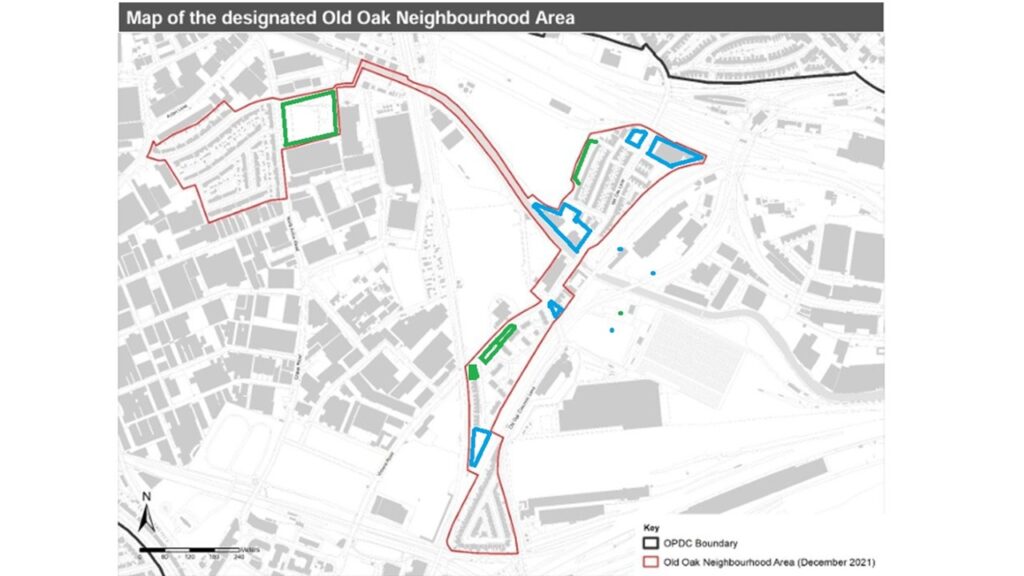
Draft Old Oak Neighbourhood Plan proposals – the five potential development sites are with blue oulines. Proposed Local Green Spaces with green outlines.
The legal opinion obtained by OPDC from Landmark Chambers can be downloaded below:
The Forum will continue to try to resolve these differences of view with OPDC. This will mean a hold up of a few weeks before we formally launch a 6 week ‘Pre-Submission Consultation on the Draft Neighbourhood Plan. In the meantime a preliminary version can be read and downloaded here.
The third meeting of the Panel took place on February 12th. The agenda circulated in advance (which will be on the OPDC web pages for the Panel) did not include all the items which we had asked in advance to be discussed. But OPDC relented and we were able to raise these topics.
HS2’s Peter Gow attended the meeting, which was very welcome. Peter is project manager for Old Oak Common station. His important news was that the outcome of the ‘comprehensive reset’ of the HS2 project should be announced before the end of February.
The timeline for the opening of the Birmingham to Old Oak HS2 line will still not be be a firm date, but as a range of years (as was the previous 2029-33 forecast). The announcement will probably include new governance arrangements for HS2, and without giving final revised costs. But local residents at Old Oak may at least gain a better idea of how much longer the disruption to their lives will continue (2026 was the original date for completion of the project).
The recent start of the tunnelling between OOC station and Euston is seen by HS2 and OPDC as a vote of confidence in what remains of the HS2 project. Plans for a Euston terminus are still not finalised, nor funded. This part of the overall project is now handled by the Department for Transport and not by HS2 Ltd.
The Panel meeting discussed the continining difference of view between the Old Oak Neighbourhood Forum and OPDC, on the ‘material weight’ and importance of OPDC’s new Masterplan Framework. While OONF agrees that this 200 page document can be a ‘material consideration’ in future planning decisions, we don’t accept that its proposals should override the adopted 2022 OPDC Local Plan. The Local Plan is the statutory context for deciding all applications, consulted on and ‘examined’ by a Planning Inspector.
The Masterplan Framework is described as ‘illustrative’ but the published version also includes a paragraph saying that all applications for development must take account of its contents. Our view is that the document has only limited material weight, as compared with an adopted local plan. This lack of certainty may trouble the prospective ‘master developers’ with whom OPDC hope to enter into joint ventures to deliver their new Masterplan.
The position will change over time, once OPDC’s promised review of the 2022 Local Plan gets underway. In the meantime we have had to agree to disagree with OPDC on this subject. The background is covered in a separate post on this website, updated to include our most recent letter to OPDC.
We also raised at the Panel what we see as misleading claims by OPDC that the Masterplan area is ‘well connected‘ to public transport. While this may be true for those living close to Willesden Junction or North Acton station, the areas inbetween have poor connectivity (using existing standarsd measures). Our members at Old Oak see local bus services as worse now than a decade ago.
The situation will of course change once Elizabeth Line platforms are operational at OOC station. But HS2 say that early opening of these lines would only be shortly in advance of the remainder of the rail interchange. Government support and funding for the West London Orbital, with a new rail station in Old Oak Common Lane would be another game changer. But for the time being the Government has given priority for investment to the DLR Extension in east London.
We feel that we have to keep reminding OPDC that improvements to the transport network at Old Oak remain a future prospect and not a present reality. Until new infrastructure is in place, much of the Masterplan area remains unsuitable for high density/high rise/car free housing of the kind envisaged in the Masterplan.
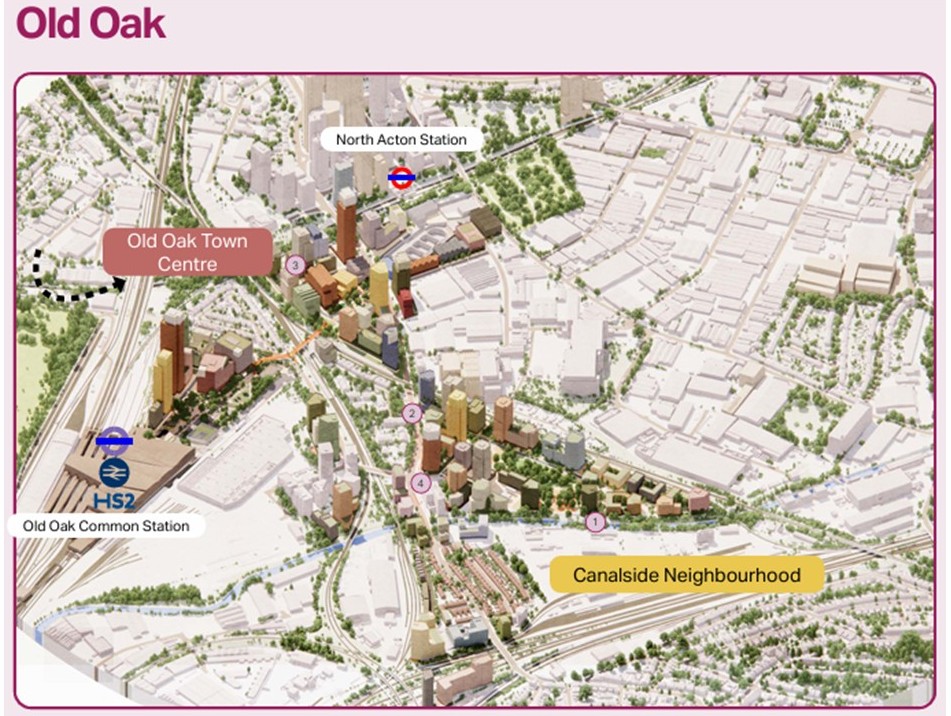
Image from OPDC’s 2025 Masterplan Framework
OONF slide set questioning OPDC’s current approach to their delivery plans
At the last OONF/GUA Zoom session we looked at a set of slides intended to provide some challenge and critique to OPDC’s insistence on proceeding ‘at pace’ with its delivery ambitions. Until new transport infrastructure has arrived, building ‘more of the same’ high rise/car free apartments as shown in the Old Oak Masterplan area does not seem to us to be exemplary urban renewal
‘Part 1’ of this slide set is below. As explained to OPDC at the Panel meeting, we wanted the Chair Dame Karen Buck and chief executive Matthew Carpen to be aware of their content – as we will be using some of these slides when approaching London Assembly members, Borough Leaders and officers, and other local groups about our proposed 2026 Draft Old Oak Neighbourhood Plan.
As discussed at recent monthly Zoom sessions, we are reviving the idea of submitting to OPDC a Draft Neighbourhood Plan. OPDC would then need to publish and consult on this for 6 weeks, before ‘examination’ of the Draft Plan by an independent examiner.
Such a neighborhood plan would offer an alternative way forward for OPDC, should they find that investment interest from the major developers being sought as delivery partners turns out to be not as strong as OPDC hope.
As has been widely resported, there is limited interest in new housing construction in London at present given lack of financial viability. It remains to be seen if the MHCLG/Mayoral ’emergency package’, reducing affordable housing requirements (along with CIL charges) has much impact.
We are suggesting the neighbourhood plan route as a contingency option, should OPDC’s plans come unstuck at a difficult time in the London development market. This alternative route would involve lower density mid-rise housing on the sites which OPDC has purchased, perhaps with the GLA working more directly with housing associations and contractors using Modern Modular Construction techniques – at scale and at speed.
No sign of any enthusiasm from OPDC as yet. Before the end of February we will discuss with officers the feasibility of a ‘co-operative’ neighbourhood plan. This would include the scope for extending the 2021 neighborhood boundary to cover most of the Masterplan area. A neighbourhood plan, if successful at a local referendum, has the full statutory weight of the Local Plan. Once next steps become more clear, the earlier draft neighbourhood plan which has sat on this website since 2021 will be replaced with a new version. Local consultation would then get underway.
The OPDC Delivery team has been working over 2024/5 in preparing proposals which have now been published as a Masterplan Framework. The version of the document as endorsed by OPDC Board on Novermber 20th 2025 can be downloaded from the OPDC website. This is not yet the final version, and OPDC officers have delegated authority to make final amendments.
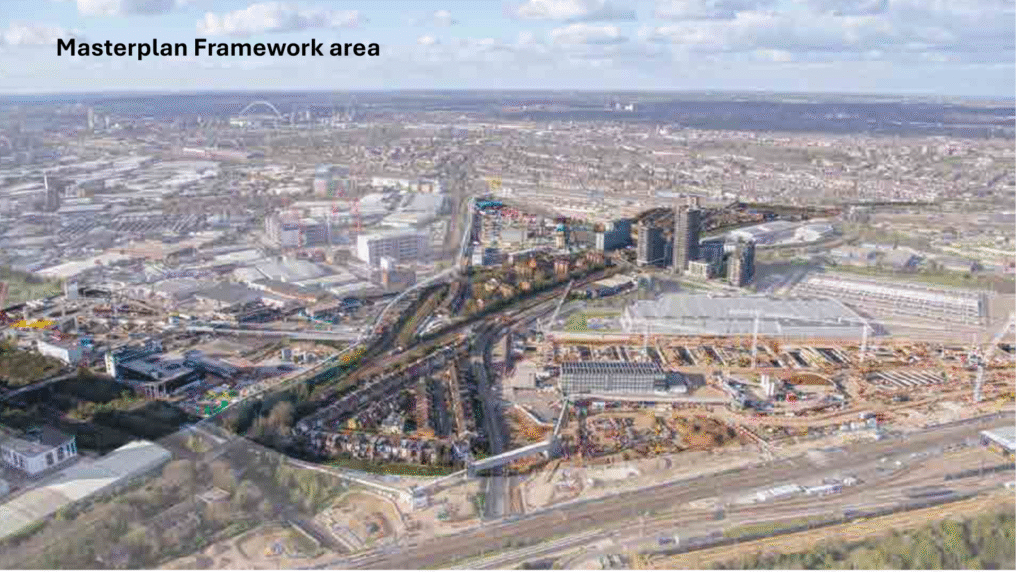
The area covered by the Masterplan Framework runs from Willesden Junction to North Acton station.
The OPDC’s proposed Complulsory Order covers this same area. This Order was approved (‘made’ by the OPDC on September 12th and those affected had the chance to submit objections by October 8th 2025. The OPDC team are currently trying to reach agreement with objectors, before submitting the final draft Order to the Secretary of State of State. A public inquiry is now expected in the autumn, rather than the earlier part of 2026.
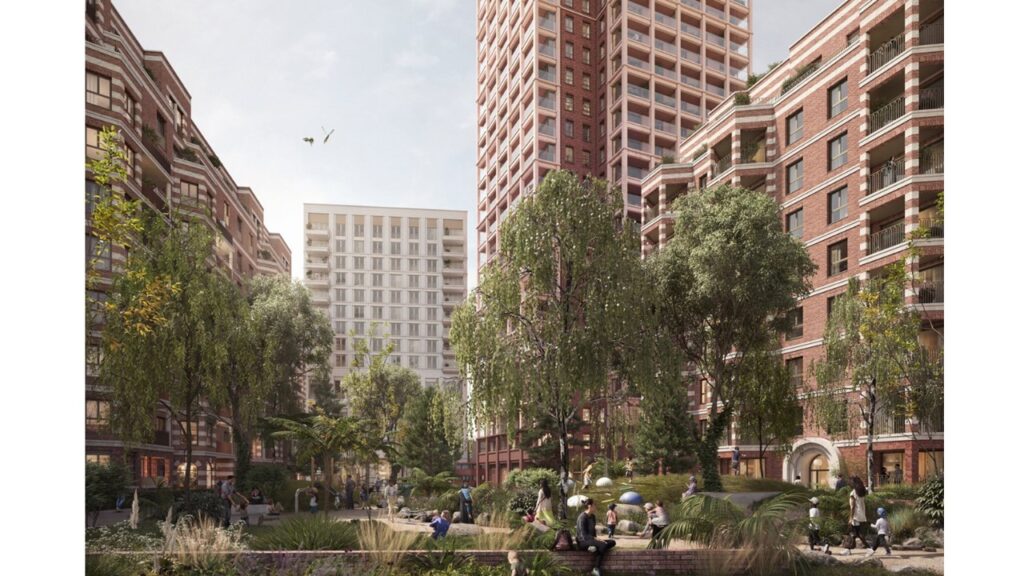
The Masterplan Framework will be a key document in discussions and negotiations between OPDC and prospective ‘master developer’ partners during 2026. It defines OPDC’s aspirations for high-density high- rise development delivering around 8,000 housing units and 150,000-200,000m sqm of employment space. A CGI of the potential outcome of such development is below:
In recent months, our neighbourhood forum has been questioning OPDC about the status of this Framework document in relation to the OPDC’s 2022 adopted Local Plan. OPDC consulted on a set of ‘Spatial Principles’ and an ‘Illustrative Masterplan’ during 2024 and 2025. At this stage, the maps and images presented to the public were described as one way in which the area might be developed.
The November 2025 Planning Committee was advised that the Framework will enable OPDC (as delivery agent) to inform, guide and coordinate future planning applications across the Old Oak area. In relation to the 2022 Local Plan, the committee report explained that While the Masterplan and Framework are capable of being material considerations for planning decision-making purposes, the judgment as to the weight they should be given will be for the Local Planning Authority to make when considering particular applications, in accordance with usual practice.
This wording of ‘capable of being material considerations‘ prompted OONF to query with OPDC the status and significance of the Masterplan in relation to the Local Plan. Our first letter on this subject is below:
No reply was received to this letter, so we wrote again on 1st December objecting specifically to the wording in the Framework stating that All detailed development proposals within the Old Oak area are expected to take account of the vision, principles and guidance set out in the Masterplan Framework. We questioned why OPDC had not chosen to prepare the Framework as a development plan document, thereby updating and replacing policies and site allocations in the 2022 Local Plan.
We also objected to a section of the document on ‘The Place Today‘ claiming that Old Oak is an exceptionally well connected with the new HS2 and Elizabeth Line station at Old Oak Common, Willesden Junction providing Overground and Bakerloo line services, and North Acton linking to the Central Line. This scenario of ‘connectivity’ remains 10-15 years into the future.
This did not answer all our questions, but confirmed that OPDC was taking ‘extensive legal advice’ on the way in which the Development Corporation is proceeding on its Masterplan Framework. The email used wording similar to that used by OPDC’s Director of Planning at the November OPDC Board that It would be irresponsible for me to make predictions as to the weight of the masterplan framework at the time of making a planning decision as this would fetter our discretion.
As we see the position, there remains insuffient clarity on whether OPDC see the Masterplan Framework effectively as a replacement for policies and site allocations in the 2022 Local Plan, with these new 2025 proposals taking precedence. While the email gave an explanation of why OPDC has not chosen to update its Local Plan via a Partial Review, or one or more Area Action Plans (which are development plan documents), we have so far found their reasoning to be unconvincing. Hence our third letter sent on 9th December 2025:
We continue to feel that for OPDC to proceed with their delivery programme on the basis of a non-statutory masterplan remains a risk. As compared with other major regeneration projects that have taken place in London, this situation creates a level of uncertainty for all parties involved. Developers will not know whether their proposals should meet all the policy requirements in the 2022 Local Plan (and the London Plan)? Or should they pay more heed to the content (mainly maps, diagrams, and drawings) in the Framework document. How will Planning Inspectors interpret the ‘material weight’ of the Masterplan in the event of a refusal and appeal?
Our latest letter to OPDC is below. We think that this correspondence may resurface at a later date, should legal issues arise on how the Masterplan is used by OPDC’s Planning Committee in making future decisions on planning applications.
For the time being we have ‘agreed to disagree’ with OPDC planning officers on this subject. OPDC have confirmed that there will be no single outline planning application for the masterplan, consent to which would give developers greater certainty in framing their own subsequent applications. This was the route used in 2006 to underpin regeneration at Kings Cross. Nor will there be any Area Action Plans or Supplementary Plans prepared by OPDC (both of which have ‘developent plan’ status) in advance of the full revision of the OPDC Local Plan. OPDC’s timeline for adoption of an updated Local Plan is autumn 2028.
We await a final published version of the Framework document, to see if any of the wording to which we have objected is reframed or removed.
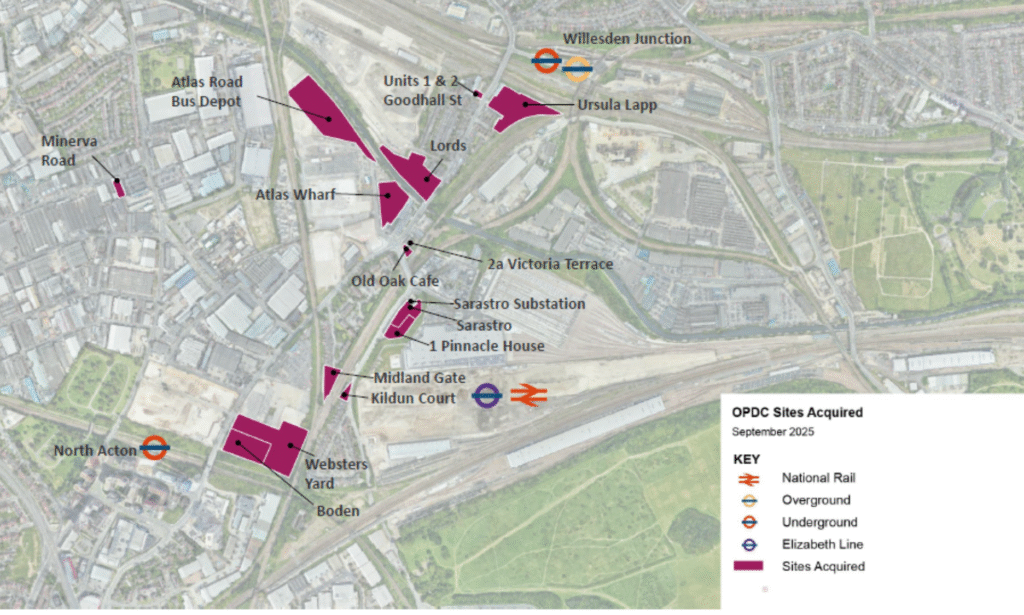
OPDC has prepared a Compulsory Purchase Order covering 31 hectares of land at Old Oak West. Many of the properties and sites involved have been acquired by OPDC by agreement with owners during 2o24 and 2025. But OPDC see a CPO process as necessary to demonstrate that they have control of remaining sites (some 10% of the area) as part of their efforts to secure a ‘Master Development Partner’.
The development partner (or possibly partners) would enter into a joint venture or development agreement with OPDC, to develop individual sites with schemes in line with the Illustrative Masterplan that OPDC has been working on with its team of consultants led by architects/planners Gort Scott.
The ‘CPO Order’ was ‘made’ (meaning adopted) by OPDC on September 12th, Full details are available from the OPDC website at this link Old Oak Land Assembly Update. Objections have to be submitted the MHCLG Planning Decisions Unit by midnight October 8th (and can be emailed to pcu@communities.gov.uk). All our members have been alerted to this deadline.
Meetings of OONF and GUA members at our monthly Zoom sessions have discussed the CPO proposals. For several reasons, we think that the timing is wrong and that CPO powers should not be used by OPDC until the outcome of the HS2 ‘reset’ is known, sometime in 2026.
We don’t agree with OPDC’s insistence on proceeding ‘at pace’ with its Masterplan and partnering with a master developer. Their masterplan varies from the 2022 adopted Local Plan, shifting the proposed ‘major town centre’ from Atlas Wharf/Channel Gate to Acton Wells. The development sites near the Grand Union Canal now owned by OPDC are seen as the ‘first phase’ of housing development, with around 1,500 new homes.
Our fear is that these sites will be built out as very high density car-free blocks, comparable to Oaklands Rise. Planning consents will be granted on the assumption that Old Oak Common station will improve the existing low levels of access to public transport. But this will not be until 10-15 years hence and might not even happen if the HS2 reset proves to be unviable or unaffordable compared with other high priority UK infrastructure projects.
Our detailed objection to the CPO Order is below. Several property owners are thought to have objected also. If agreement is not reached with these parties, a Public Inquiry on the CPO will take place – possibly in Spring 2026.
As part of our objection we have referred to the proposals worked by OONF along with the Grand Union Alliance, Harlesden Neighbourhood Forum, and StQW Neighbourhood Forum in North Kensington. These were for medium density housing at the Atlas Road/Channel Gate triangle with a 10-15 year lifespan – so that the impact of HS2 and Old Oak Common station could be tested in real life.
These proposals were presented to a session of OPDC’s Planning Committee on September 8th 2021, but dismissed out of hand. Our related application to OPDC to extend the boundary of the Old Oak neighbourhood area was also ‘refused’. Given current efforts by the GLA to deliver modular housing on available sites to ease the homelessness crisis, we think that our 2021 suggestions merit another look. The presentation is below.